















This seminar will introduce Prime Editing, a next-generation genome editing technology that addresses key limitations of conventional CRISPR/Cas9-based editing, including specificity and cytotoxicity.
Participants will gain insights into practical design strategies to improve editing efficiency and reproducibility, including optimization of mRNA-delivered Prime Editor systems, pegRNA stabilization, and the use of chemically modified RNA such as UNA for off-target control.
Through real-world case studies in cellular systems, this session will provide actionable guidance for implementing Prime Editing in research workflows.
This seminar will be conducted in English.
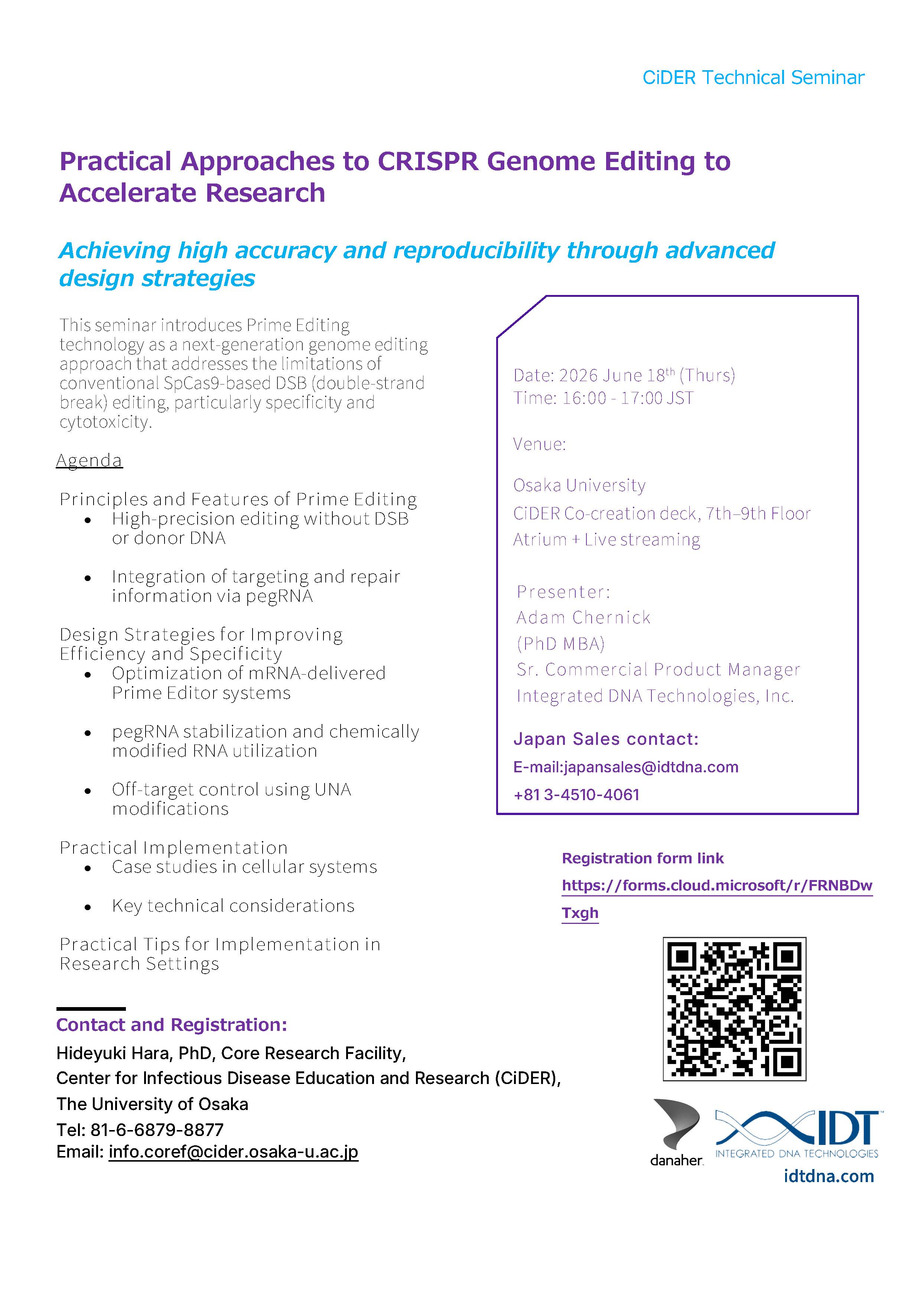
Date: 2026.06.18 Thurs 16:00–17:00 JST
Osaka University
CiDER Co-creation deck, 7th–9th Floor Atrium + Live streaming
(Opens an external site)
Program
- Current challenges in CRISPR/Cas9 genome editing
- Principles and features of Prime Editing
- Precise editing without DSB or donor DNA
- Integration of targeting and repair information via pegRNA
- Design strategies to improve efficiency and specificity
- Optimization of mRNA-delivered Prime Editor systems
- pegRNA stabilization and chemically modified RNA
- Off-target control using UNA modifications
- Practical implementation in cellular systems
- Key considerations for research applications
Speakers
Adam Chernick(PhD, MBA)
Sr. Commercial Product Manager
Integrated DNA Technologies, Inc.
Target
・Researchers working on genome editing technologies・ Scientists interested in next-generation CRISPR applications ・Academia, pharmaceutical, and translational research communities
Participation Fee
Free
Organizer
Osaka University(CiDER)
Integrated DNA Technologies K.K.
Contact
Hideyuki Hara, PhD, Core Research Facility,
Center for Infectious Disease Education and Research (CiDER),
The University of Osaka
Tel: 81-6-6879-8877